
How Brazil, Mexico, and India rebuilt the GTA formula around their own cities—from indie hits like 171 to ambitious projects that ran out of money.
For two decades, developers around the world have used “the GTA of our country” as shorthand for open-world crime games: Brazil’s 171 and Gangstar Rio, Mexico’s Total Overdose, India’s Mayanagari and Mumbai Gullies. Some are commercial games, some are fan-made mods, and a few are ambitious local projects that ran out of money before shipping. This article looks at what happens when the GTA formula leaves its fictional American cities and is rebuilt around real local streets, languages, and social realities, and why a local map is rarely enough.
For more than two decades, Grand Theft Auto has been more than a commercially successful franchise. It has become a design language.
Players instantly understand the promise: a large contemporary city, freedom of movement, cars, weapons, police chases, and the chance to cause chaos between missions. The formula is so recognizable that the gaming press routinely labels new projects “the Brazilian GTA,” “the Indian GTA,” or “GTA in Mexico.”
“Clone” is a handy marketing shortcut, but not always an accurate description. The more interesting question is what happens when developers take the formula out of its fictional American cities and rebuild it around their own streets, languages, vehicles, humor, and social realities.
Four ways to create a “local GTA”
Country-specific GTA-like projects usually fall into four broad categories:
Commercial GTA-inspired games with original worlds, characters, and IP.
Mobile reductions of the formula: touch controls, short sessions, free-to-playA model where the game is free to download and earns money through in-game purchases or ads. monetization.
Fan modifications and bootleg editionsUnofficial modified copies of a game, often sold or passed around as if they were separate releases. that swap vehicles, signs, music, or textures in an existing GTA game.
Local urban sandboxes that start with GTA mechanics but drift toward role-playing, simulation, or online platforms. (We covered how this happened with SAMP in From Spacewar to SAMP.)
Brazil offers examples of almost all four.
Brazil: From imported stereotypes to locally built streets
Gangstar Rio: GTA goes mobile
One of the earliest big attempts was Gameloft’s Gangstar Rio: City of Saints (2011, iOS and Android): driving, shooting, police attention, and criminal missions in an open-world Rio. In its review, Pocket Gamer said the game copied the GTA formula quite openly but lacked its narrative depth, humor, and polish.
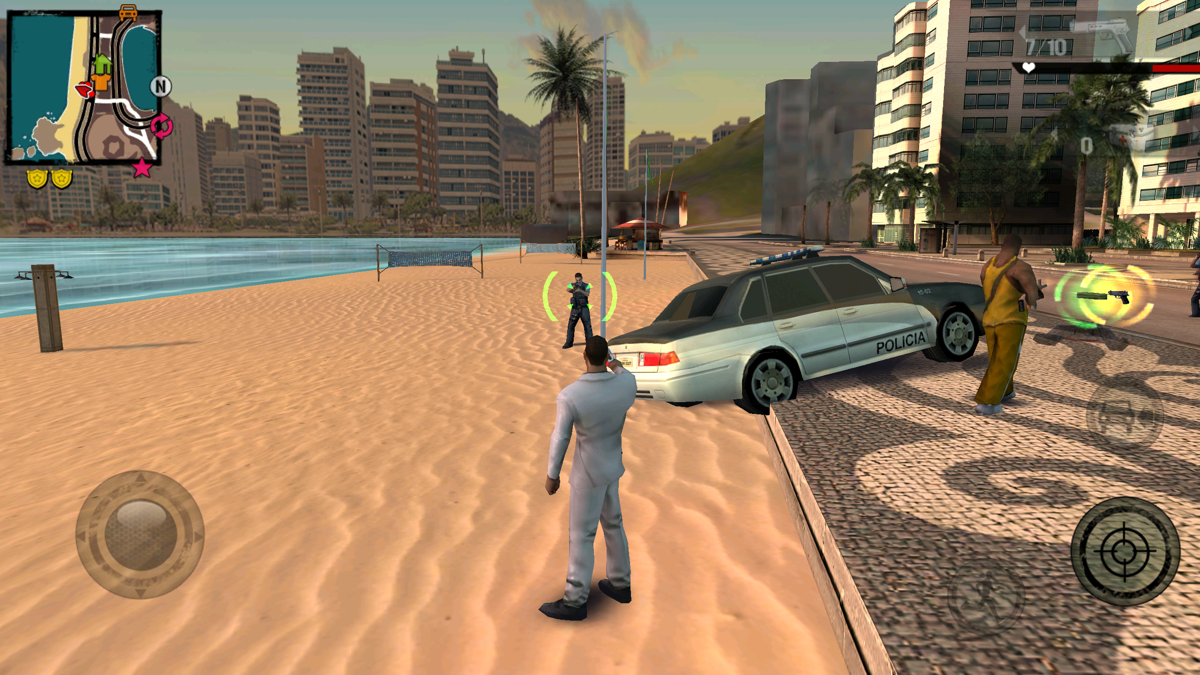
Rio’s coastline and hills gave the game an instantly recognizable identity, yet it showed Brazil through familiar international crime-game imagery: gangs, favelas, weapons, exaggerated violence. The location was Brazilian, but the perspective stayed external.
GTA: Rio de Janeiro and bottom-up localization
Insight. Fan editions like GTA: Rio de Janeiro are a textbook case of bottom-up localizationAdaptation that comes from players and communities themselves, not from the publisher.: players adapting a game to their own culture instead of waiting for a publisher to do it.
Brazil also developed a culture of unofficial GTA editions. Modified copies of San Andreas circulated as GTA: Rio de Janeiro and GTA Brasil, and during the PlayStation 2 era they were sold in informal shops as if they were separate games. According to Kotaku’s database entry, there was no single standard release: different creators replaced cars, ads, music, textures, and sometimes parts of the map with Rio-inspired material.
Technically, many were modest. Culturally, they mattered. They exposed a demand the official series ignored: players wanted familiar cars, Portuguese-language music, local references, and an environment that looked like home. Brazilian modding communities carry this tradition on today.
171: The “Brazilian GTA” built around familiarity
The most prominent independent answer to that demand is 171 from Brazilian studio Betagames Group, in Steam Early AccessA Steam program that lets players buy and play a game while it is still in development. since November 17, 2022. Its fictional city mixes poorer neighborhoods, middle-class areas, and commercial zones modeled on Brazilian cities. The systems will be familiar to any GTA player: cars and motorcycles, firearms, police attention, legal and illegal jobs, shops, enterable buildings, random events. There is no full campaign yet, though the developers say more than 20 updates have shipped.
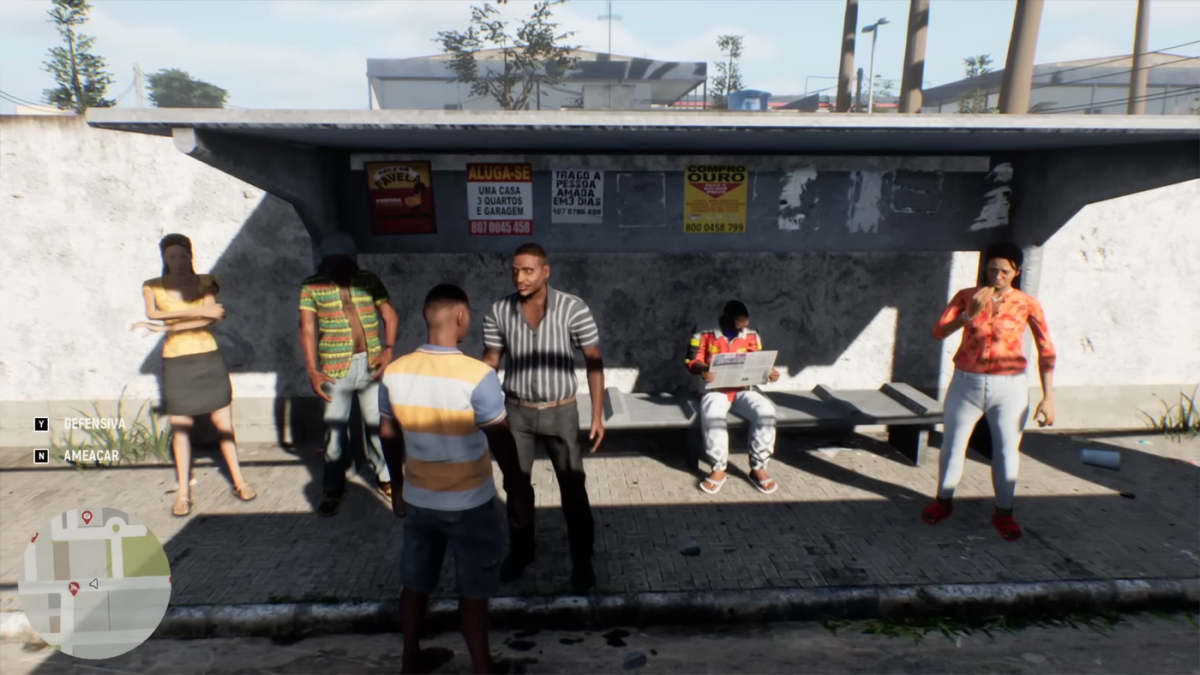
What sets it apart is the density of recognizable details: Brazilian Portuguese, motorcycles, local architecture, informal commerce, clothing, and the contrast between social environments. Even the title is local: Article 171 of Brazil’s Penal Code covers fraud, and the number has become slang for a swindler. Calling 171 a clone explains its mechanics but misses its appeal.
The debate. The project also drew criticism from within Brazil’s modding scene. Junior_Djjr, creator of MixMods, argued in “Jogo 171 — Ainda não era o bastante” that crowdfunding backers may not have been clearly told that some expensive-sounding goals would be met with inexpensive marketplace Unreal Engine assets. His updates after launch claimed that systems like the day-night cycle, vehicle physics, and NPC behavior rely on third-party packages. He stresses that using commercial assets is normal and that he is not accusing the team of fraud: his issue is transparency and what supporters believed they were funding. This is one critic’s position, not an audit.
It does expose a tension around every “national GTA.” Fans treat them as symbols of a country’s game industry and compare a small team to Rockstar, while the developers may need marketplace tools, community funding, and long Early Access just to make an open world possible. Brazil’s modders, who built vehicles, maps, and total conversions for years with no funding, add a third yardstick.
Mexico: A popular setting, but often someone else’s Mexico
Mexico is a favorite crime-game setting, but many of the best-known GTA-like takes on it came from studios elsewhere.
Total Overdose: GTA through an action-movie lens
Danish studio Deadline Games released Total Overdose: A Gunslinger’s Tale in Mexico in 2005, with an explorable Mexican setting, cartels, DEA operations, and street violence. Many reviewers filed it under GTA clones, but VideoGamer noted that it plays very differently: slow-motion shooting, combo scores, and acrobatic “Loco Moves” make it an arcade action game. Its Mexico is a deliberate pile-up of cartels, luchadoresMasked professional wrestlers, a staple of Mexican pop culture., and mariachi, closer to a Robert Rodriguez fantasy than to contemporary life.
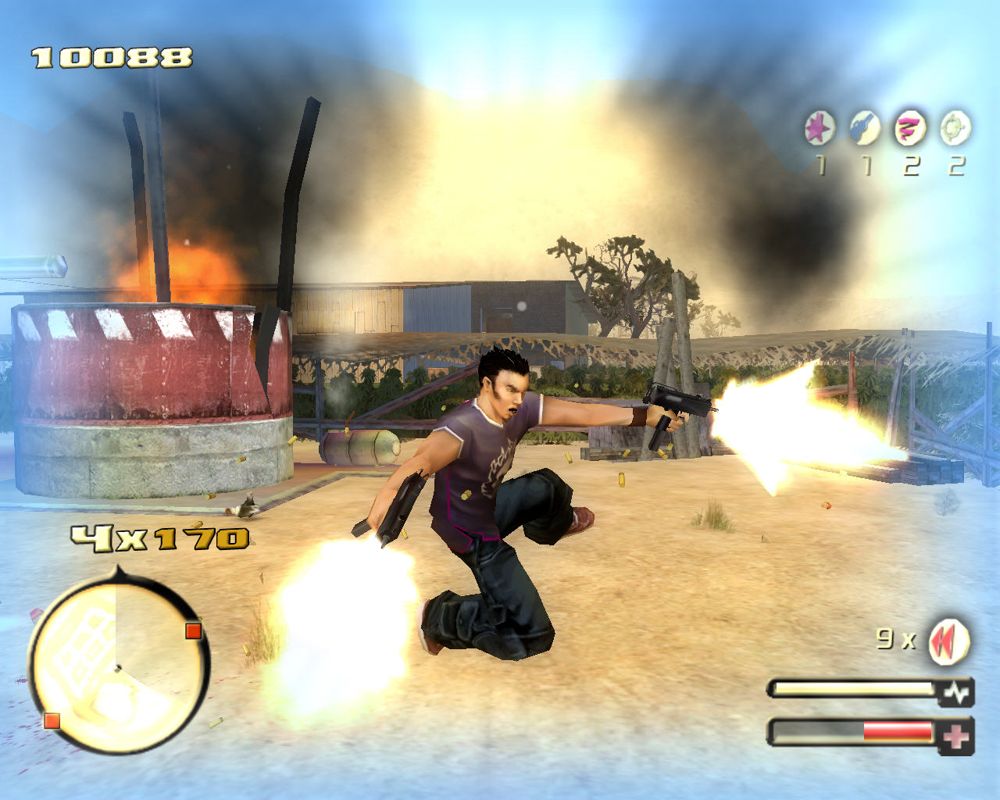
That reflects a broader pattern. In a WIRED essay, historian Emiliano Aguilar argues that mainstream games keep portraying Latin America as exotic, corrupt, and violent instead of exploring its real history and diversity.
GTA México as a fan-made category
Mexican players made their own adaptations of San Andreas, such as GTA México and GTA Mexico City: collections of mods from different creators that replace cars, buses, shops, music, signs, and skins. Quality varies wildly, but the function is the same as in Brazil. Players don’t always want a new story. Sometimes they just want the streets to contain the vehicles, slang, and visual clutter of their daily life.
India: National ambition meets the cost of an open world
In India, “Indian GTA” became an effective way to draw attention to ambitious local projects, for both PC and mobile.
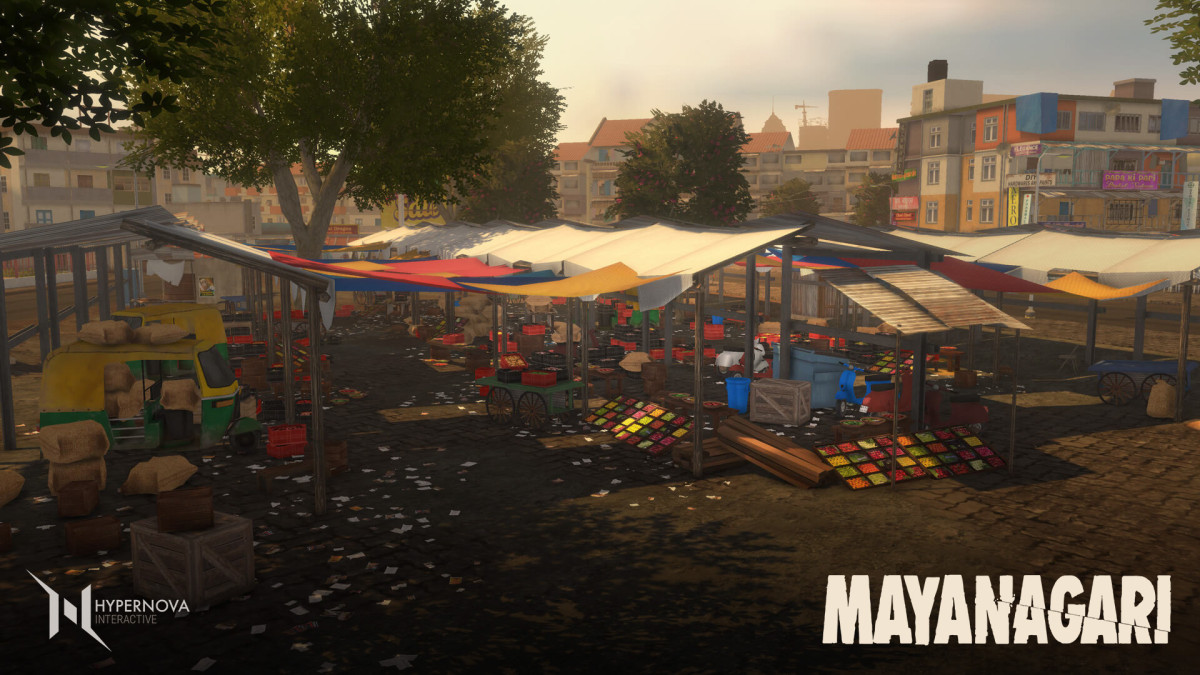
Mayanagari. Hypernova Interactive announced it as a mobile open-world gangster game. According to Hardcore Droid, it was built around Mumbai and Goa, Hindi-language content, local vehicles, and Bollywood-style cutscenes. Like Gangstar Rio, it squeezed the GTA promise into a phone, but it presented itself as a locally made interpretation rather than an outside view.
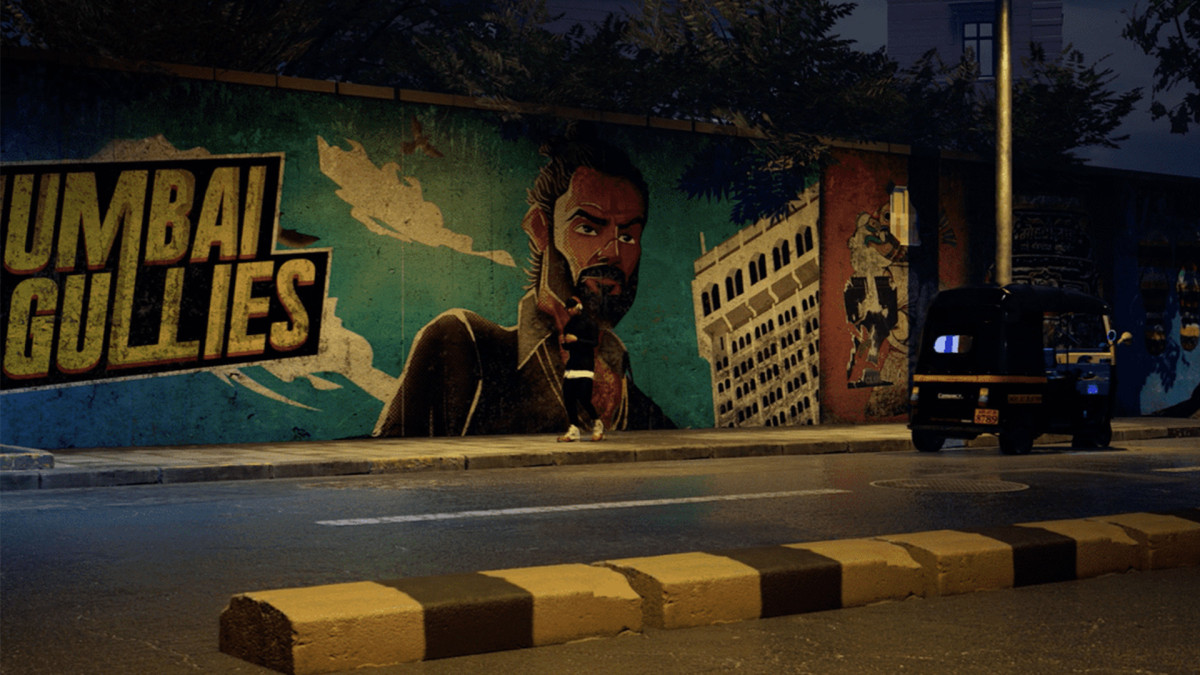
Mumbai Gullies.
Insight. Mumbai Gullies is a cautionary tale: the “national GTA” pitch attracted attention and investment, but the project stalled after years of work without a public playable build.
This PC project pitched an open-world game about Mumbai’s underworld. A detailed 2026 Outlook Respawn investigation reports that development stopped after years of engine changes, internal difficulties, and mounting losses, and that no public build was ever released.
The lesson: GTA is easy to describe and extraordinarily hard to build. A convincing sandbox needs traffic, pedestrian behavior, police AI, vehicle physics, interiors, mission scripting, radio, economy systems, optimization, and enough content to make a city feel alive. The comparison buys instant visibility and expectations that can crush an indie studio.
A local map is not enough
The weakest GTA-likes treat cultural adaptation as a texture pack: flags, monuments, local police cars, a few songs, and familiar stereotypes. Authentic culturalizationAdapting a game to a specific culture beyond language: context, references, humor, social realities and user habits. goes deeper:
- how neighborhoods are organized and which vehicles dominate the streets
- how people address each other, and which jokes and gestures feel natural
- what informal businesses exist and how social class shapes the city
- what appears on billboards, storefronts, and radio stations
- how players expect menus, monetization, and online interaction to work
Localization is not just swapping one language for another. It is adapting content to a specific culture and audience, including context, references, and user habits. We explore this in How Game Localization Differs from Other Types of Translation. An urban open world makes it especially visible: every sign, pedestrian, radio ad, and joke becomes part of the localized experience.
Why “the GTA of our country” still works
Despite the risks, the comparison packs a lot into three words. “The Brazilian GTA” promises a city, cars, crime, and freedom. It also promises something Rockstar has rarely delivered: your own country at the center of a big open world. Local versions capture regional culture and landscapes that even Rockstar, with its budget, couldn’t cover.
The people behind these projects (owners, developers, streamers, and players) carry the rebellious spirit of the original games. Judging by their social media, they drive fancy cars, party with rappers, and try to make money doing what they love. Sometimes those attempts aren’t quite legal and step on Rockstar’s rights. But these are GTA’s truest fans, chasing success by the game’s own rules. As a famous Russian internet meme puts it, “a kid was heading for success.” It’s a tongue-in-cheek line about a streetwise hustler with a dream, and in Los Santos, that is basically the American Dream with a wanted level. So does Rockstar have the right to judge its most devoted fans? We look at how that conflict has played out, from bans to buyouts, in GTA Modding, Part 2.
Key takeaways
“Local GTA” projects fall into four types: original commercial games, mobile reductions, fan modifications, and sandboxes that evolve into other genres.
Brazil shows the full range, from Gangstar Rio (an external, mobile take) to 171 (a locally built commercial game) to decades of grassroots San Andreas mods.
Mexico is often depicted through an outsider’s lens (Total Overdose), alongside a large body of fan-made GTA México editions.
India’s Mayanagari and Mumbai Gullies show both the appeal and the financial risk of the “national GTA” pitch.
Swapping in local cars and flags is not real localization; authentic culturalization touches slang, humor, social structure, and everyday details.
FAQ
Disclaimer: This article is for informational purposes only and covers the topic of open-world game modding. Allcorrect supports the protection of copyright and does not endorse piracy.


