
Think console localization is just about translating button names? Not quite. Our new article breaks down why Naming Conventions can make or break certification—and how a wrong term can cost studios time, money, and release dates.
“War… War never changes.”
—Fallout
Console wars aren’t just fought through exclusive titles, in sales statistics, or in the fiery comment sections of video game forums. They’re fought on the localization battlefield, too.
Anyone can run into this obstacle whenever a game drops on a specific platform (Xbox, PlayStation, Switch), and it becomes an absolute minefield during multi-platform releases. What is it called? Naming Conventions (NC). In short, Naming Conventions are the strict, mandatory terminology guidelines set by platform holders. Every console has its own specific vocabulary and rules for how its hardware and interface features must be translated.
Many indie or first-time developers don’t realize that optimizing a game for different systems isn’t just about the code—it’s about the words, too. Unique trademarked terms are pretty obvious (DualSense, Joy-Con, Game Pass), but there are tons of overlapping terms that cause serious headaches. A single English term can have vastly different translations depending entirely on which plastic box the player has sitting under their TV.
So, What’s the Problem?
The problem is simple: if the translation of a specific term in your game’s text doesn’t strictly match the platform’s official Naming Conventions, the platform holder will not certify the game. Where can developers find these requirements? They’re provided by the platform holders themselves, usually within their developer portals:
- Sony PlayStation: Available via the PlayStation Partners portal, specifically within their TRC (Technical Requirements Checklist) and official terminology guidelines.
- Microsoft Xbox: Found in the Microsoft Game Development Kit (GDK) documentation under XR (Xbox Requirements).
- Nintendo Switch: Located in the Nintendo Developer Portal within their strict Lotcheck guidelines.
Valve is a bit of an outlier here. While they do have their own terminology for the Steam Deck, they don’t actively enforce it through strict certification failures—it’s mostly left up to the developer’s discretion.
The Most Common Naming Convention Pitfalls
- Plain old mismatch: The translated terms simply don’t match the current, official Naming Conventions.
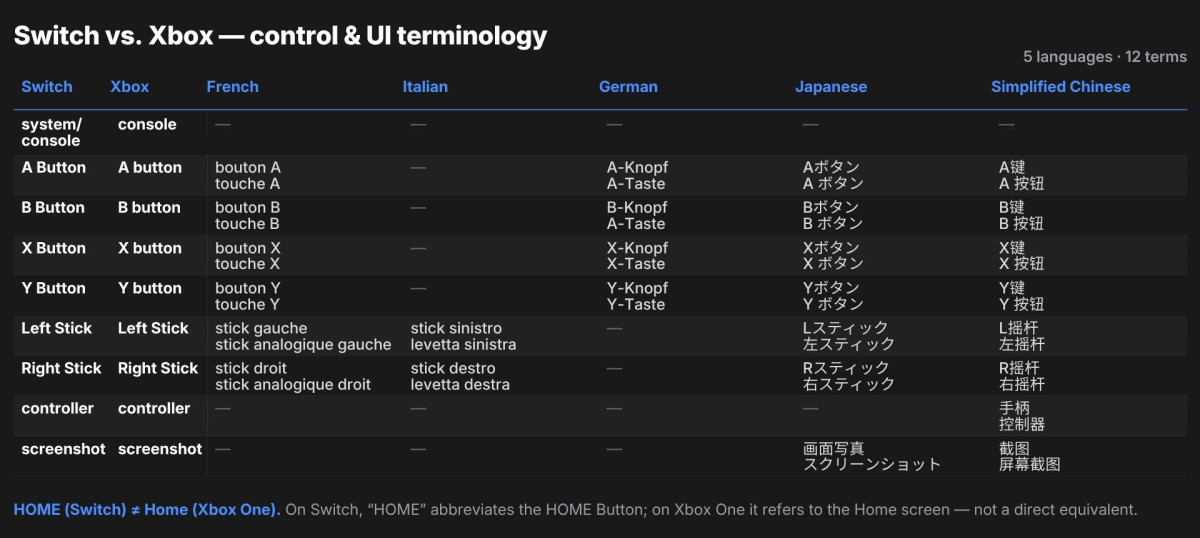
- The translation divergence: Terms that are identical in English might differ entirely in other languages depending on the platform. For example, as seen in our localization checks, the English “A Button” is translated to German as “A-Knopf” on Switch, but “A-Taste” on Xbox.
- Generational gaps: Failing to account for terminology changes between console generations. For instance, prior to the PS4 Pro, developers were strictly required to use the word “system” instead of “console” in their text. Later on, “console” became acceptable.
- Source text sins: Sometimes the original English text is flawed from the start. Developers often casually refer to L1/L2 and R1/R2 (PlayStation terms) as “bumpers” and “triggers,” which are strictly Xbox terms. Nintendo, meanwhile, insists on ZL, ZR, L, and R buttons.
The True Cost of Failing
Here’s a fun fact: the initial certification submission is usually free for registered developers. The real cost comes when you fail it.
If your translations don’t meet a platform’s Naming Conventions, they will bounce the game back. Depending on your contract, you might have to pay direct fees for subsequent resubmissions. But even without a direct fee, you’re bleeding money. You have to pay your team to fix the issues, you lose precious time, and you risk pushing back your release date—which cascades into wasted marketing budgets and a hit to your reputation.
What Is NOT Recommended
- Ignoring it: Hoping the certification team just “misses it” is an unsafe strategy. Sure, it happens, but it’s a rare exception. It’s not worth the risk.
- Omitting the words: Just dropping the tricky terms entirely usually leads to awkward phrasing and player confusion.
- Using euphemisms: Trying to cheat the system by using descriptive workarounds (like saying “input device” instead of “controller”) might occasionally bypass an automated check, but it still technically violates NC guidelines and, more importantly, sounds incredibly unnatural to the player.
What Is Recommended
- String duplication (the safest bet): Create duplicate strings for different platforms. You don’t need to do this for the whole game—just the specific UI and tutorial strings that feature NC terms.
- Using icons: Swapping out button names for images is a great workaround, but it has limits. NC glossaries are massive, and you can’t replace certain terms (like “system” or “vibration”) with a tiny picture.
- Using variables: You can set up your code to swap in the correct term depending on the platform. However, be warned: this is a nightmare for inflected languages (which includes almost all European languages). Swapping a noun using a variable often breaks the grammatical agreement of the entire sentence.
How We Handle It at Allcorrect
The idea is to catch these issues long before certification. Platform holders update their localization and marketing guidelines every couple of months, so we are constantly updating our NC glossaries to match.
Here are the steps:
1. Text analysis:
We analyze the source text against the specific requirements of every targeted platform.
2. String isolation:
We compile a list of the exact strings that require duplication for different consoles.
3. Glossary management:
We keep our internal Naming Convention glossaries strictly up to date.
4. Expert translation:
Our trained linguists translate and review the text with these platform-specific guidelines strictly enforced.
And we don’t just rely on manual checks—unless that’s a client’s preference! For clients who opt to use our advanced tech, our Smart Scoring and pre-translation analysis tools are fully calibrated to automatically flag potentially problematic NC strings before a human even looks at them.
Plus, our run.loc service includes built-in support for Naming Convention localization right out of the box.
Wrapping Up
Naming Conventions might seem like bureaucratic red tape, but they are a fundamental part of releasing a polished, professional game on modern consoles. Players expect a native experience, and platform holders demand it. By tackling NC requirements early in the localization process, rather than treating them as an afterthought, developers can limit stress and save a massive amount of time and money.
So, if you are gearing up for a multi-platform release and the thought of digging through the TRC, XR, and Lotcheck guidelines makes your head spin—don’t sweat it. We’ve got the glossaries, the tools, and the team to make sure your game passes with flying colors.
FAQ
Variables can help, but they are not a universal solution. In English, inserting a platform-specific term into a sentence may look fine. But in languages with grammatical gender, cases, articles, or agreement, the same variable can break the grammar of the entire sentence.
If your team uses variables for platform-specific terms, those strings should always be checked in context for each target language.
No. Button names are the most visible example, but Naming Conventions can cover many other terms, including controllers, accounts, profiles, network features, subscriptions, system menus, vibration, achievements, stores, user input, and other platform-specific elements.
That is why simply replacing “A Button” or “controller” is not always enough. You need to review every part of the text where the game refers to a platform, device, interface, or system feature.
No, but they are usually most critical for console releases. On consoles, platform terminology may be part of the release requirements, so incorrect names for buttons, controllers, accounts, subscriptions, or system features can result in review comments or certification issues.
This is why console localization should include a dedicated Naming Convention check before the game reaches the final review stage.
Responsibility should be shared between development, localization, QA/LQA, and production teams. Developers prepare the string structure, the localization team applies the current platform terminology, and LQA checks the result in the actual game context.
If the NC process belongs to only one team, the risk of errors increases. A translator may not see which platform a string belongs to, QA may not know the current approved term, and developers may not realize that one shared string cannot always be safely reused across all platforms.


