


Marina Lekhina
Localization of Warhammer 40,000: Space Marine 2: How to Preserve the Spirit of an Iconic IP
The localization challenge behind Space Marine 2
Hi there, I’m Marina from Allcorrect, and we’re often asked this question:
What’s the most important thing in localization of a famous IP?
Well… let’s see how we dealt with it while working on Space Marine 2.
Space Marine 2 is one of the titles we at Allcorrect have localized recently. It was developed by Saber Interactive and published by Focus Entertainment. As one of the most anticipated and highly praised titles, Warhammer 40,000: Space Marine 2 required a demanding localization process, and the main goal of this process was to reach global audiences with that unmistakable feel of the famous IP. From coordinating the localization teams to aligning with the IP holder, the decisions had to pass through several layers of review to ensure accuracy and consistency. And we went through all this with Focus Entertainment Line Producer Guillaume De Cesare.
So, let’s talk about the strategic processes and creative decisions behind the scenes.
It all began in January 2023. A quiet day at the office, emails rolling in, coffee flowing… and then—ping!—an invitation from Focus Entertainment to work on the multilingual localization of Warhammer 40,000: Space Marine 2.
I remember staring at that email for a moment. Then, I shared the news with the team. Excitement? Off the charts. But very soon, the weight of what we had signed up for started to sink in.
Looking back, we now know Space Marine 2 became Steam’s most-played Warhammer 40,000 game. But back then, we were only starting to realize what was in store for us.
You see, localizing Warhammer is not just translating words. It’s translating a 40,000-year-old nightmare of war, gods, heresy, and chainaxes into 16 languages. All while making sure the Emperor’s faithful, aka the fans, don’t burn you at the stake.
“Did you know the Warhammer universe spans hundreds of novels, dozens of games, and more lore than some actual religions?”
A universe too deep to skim
So, let me ask you this: How much lore is too much lore?
Because Warhammer 40,000 doesn’t just have a lot of lore. It has an entire galaxy’s worth.
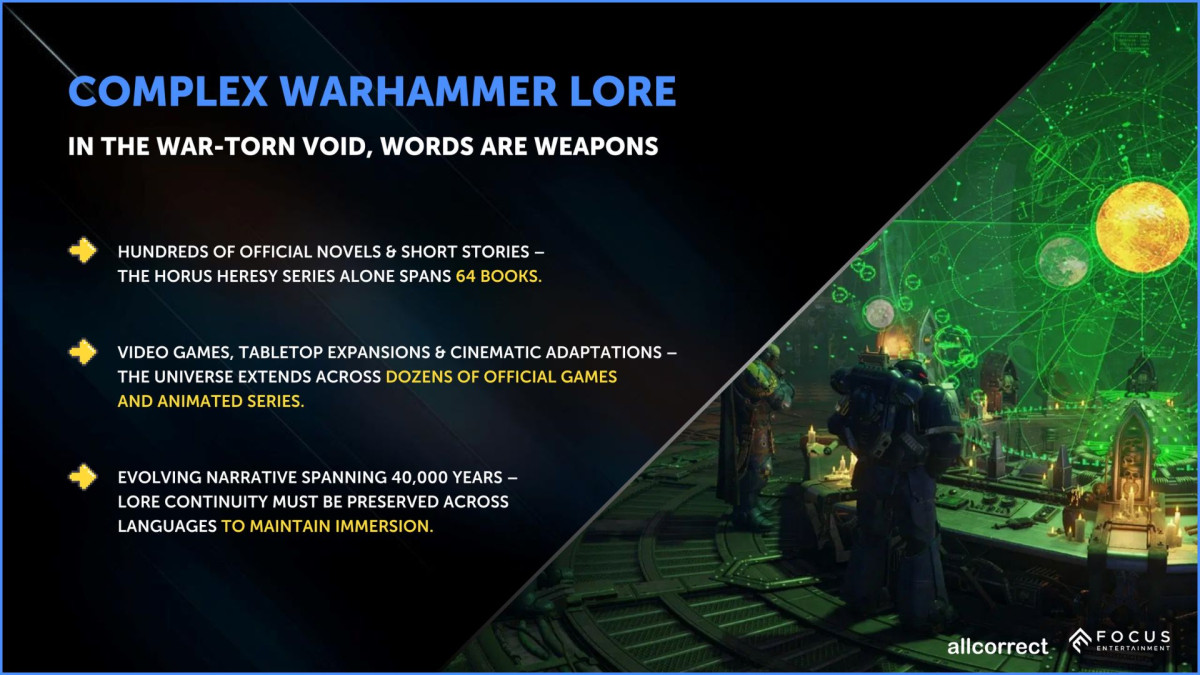
We’re talking hundreds of novels, short stories, and sourcebooks. Just The Horus Heresy main series alone spans 54 novels and short story collections before The Siege of Terra series.
Video games, tabletop expansions, rulebooks, and animated series each add more layers to the universe.
And let’s not forget: the timeline itself spans over 40,000 years of history, covering entire planetary exterminations, lost civilizations, and wars that make the apocalypse look like a minor inconvenience.
And, just in case that wasn’t overwhelming enough…
The Warhammer 40,000 Lexicanum alone currently contains more than 48,000 articles.
That’s not just deep—it’s an abyss of lore.
So… the challenge to localize a Warhammer title into 16 languages was accepted.
Localization as part of game design
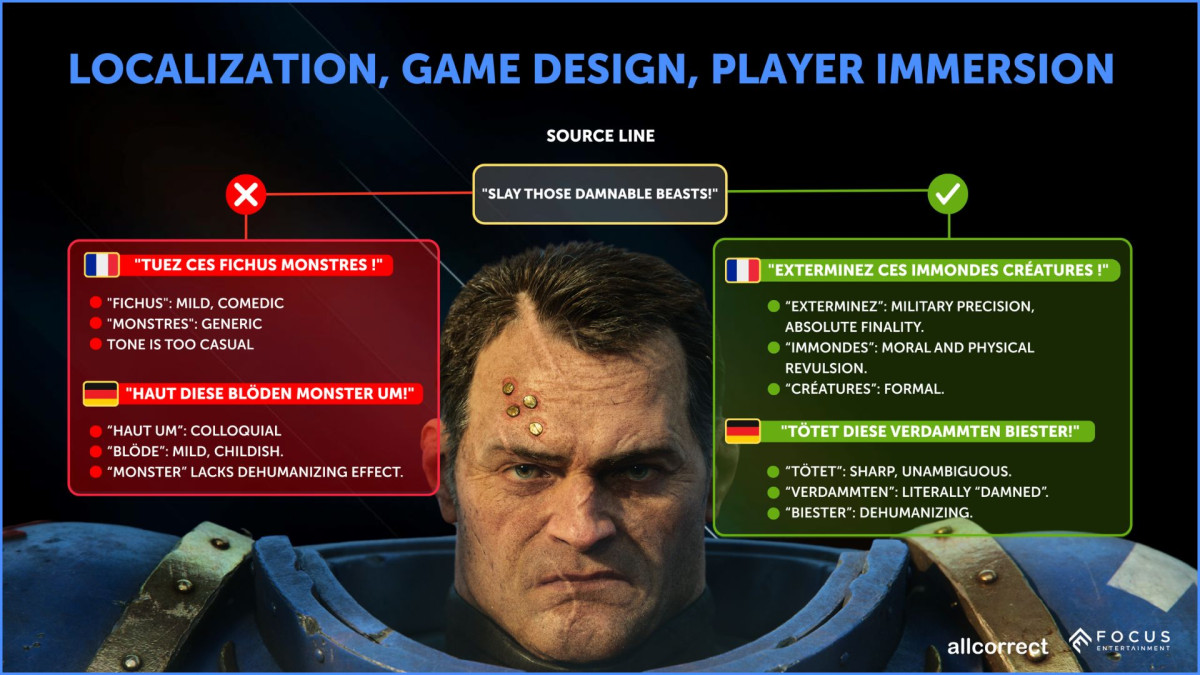
But lore is built with words, right? It’s inseparable from game design and player immersion. And localization is just an extension of game design. When it reflects the tone and mechanics accurately, it preserves player immersion and delivers a consistent experience across all markets. Here’s a simple example showing how word choices may affect gameplay.
The original line is:
“Slay those damnable beasts!”
It’s intense. It’s an order. It carries emotion, power, and danger.
Sadly, I cannot pronounce French properly, so let’s have a look at the German version.
It could be:
“Haut diese blöden Monster um!”
It’s way too casual. “Haut um” is like “smack them down,” and “blöde” means “silly” or “stupid.” It’s not something a Space Marine would say in a life-or-death fight.
Now here’s the right one:
“Tötet diese verdammten Biester!”
“Tötet” is strong and direct: kill.
“Verdammten Biester” means damned beasts. It sounds serious. It fits the Warhammer world.
So, same line, same situation. But depending on the word choices, it either feels like Warhammer… or completely breaks the mood. That’s the power of localization when it works hand in hand with game design.
Publisher expectations
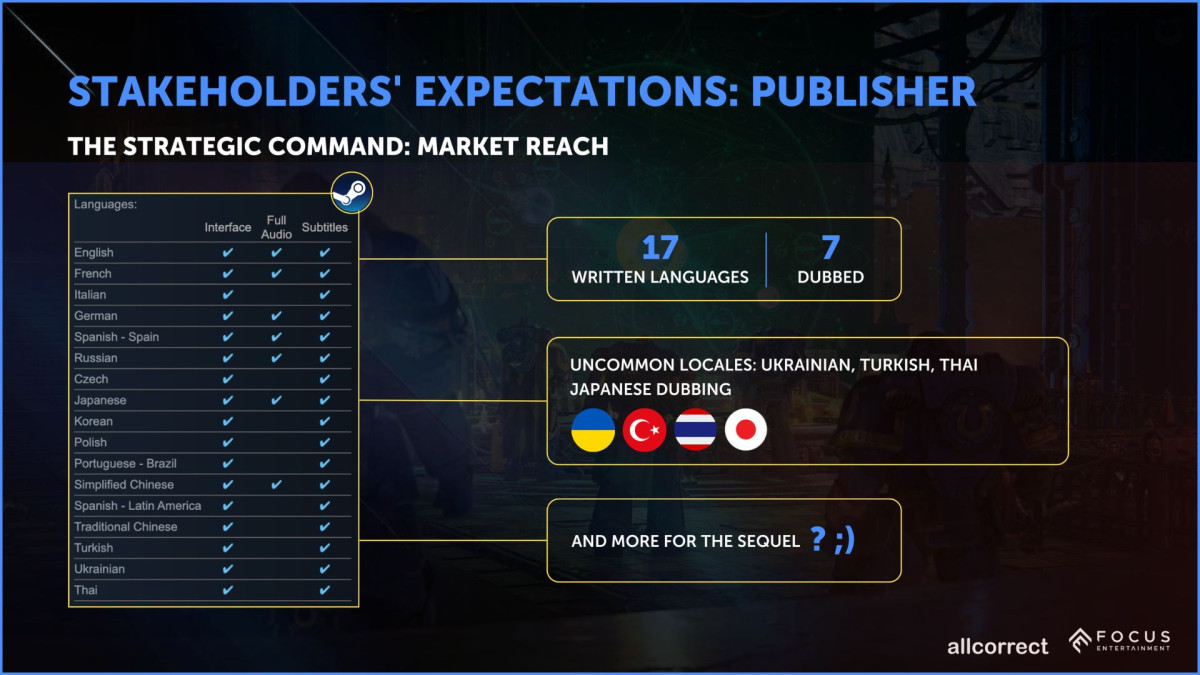
The goal of Focus Entertainment was to make sure the vision of the development team reached as many people as possible with the same quality and authenticity.
That being said, there were also economic realities. And as much as the Focus Entertainment team would have loved to include Swedish dubbing in Space Marine 2, they had to make choices about which languages they could support.
Focus Entertainment was very open to some new territories, and thanks to Games Workshop’s input, this was actually one of the first times they added Thai as a supported language. Thai came with its own set of technical challenges—unexpected ones, to be honest. But that’s how you grow: by trying new things.
Finally, the success of Space Marine 2 has already given the team a chance to dream even bigger for Space Marine 3.
Development team expectations
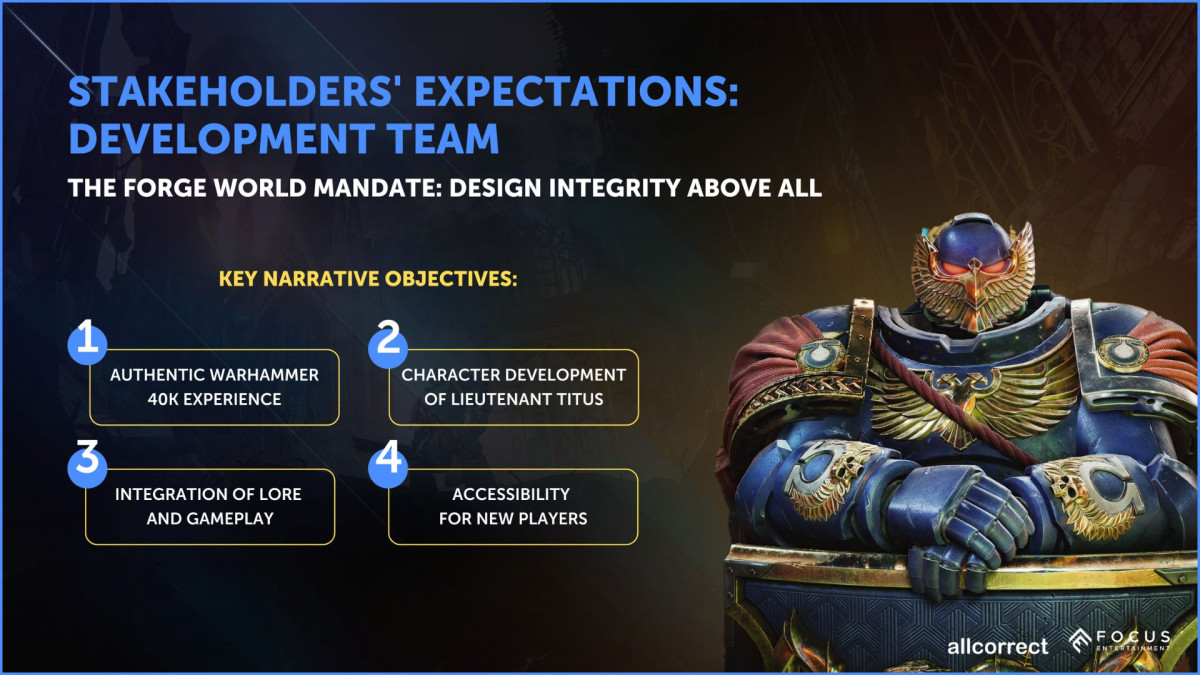
Let’s take a quick look at the narrative objectives set by Saber Interactive. Understanding their vision was very important, because if the localization doesn’t match the story, the experience feels off.
First, they wanted to create a game that feels 100% like Warhammer. That meant not just the story, but the atmosphere—grimdark, intense, full of scale and brutality. The environments, the combat, even the dialogue needed to feel big and dangerous, just like in the Warhammer universe. So from a localization perspective, we needed to preserve that tone in every line.
A big part of that tone comes from the main character: Lieutenant Titus. This game continues his story, but now he’s changed. He’s returning to the Ultramarines after time with the Deathwatch. He’s respected, but also under pressure—and the story explores that.
Saber Interactive wanted his journey to feel personal, conflicted, and weighty. So every word spoken or written for him needed to reflect that layered identity: a warrior, a leader, a symbol.
The story also had to feel woven into gameplay, not layered on top of it. Missions, environments, even mechanics were designed to reflect narrative beats. So when we localized, we weren’t just translating dialogue—we were ensuring the gameplay supported the story, and vice versa.
And finally, Saber Interactive didn’t just build Space Marine 2 for longtime fans. They also wanted it to be accessible to newcomers. So while the story continues the arc from the first game, it’s also self-contained—with enough exposition to pull new players into the universe without overwhelming them.
In short, this was not just about telling a Warhammer story—it was about living it. And that narrative vision had to inform every localization decision we made.
Games Workshop expectations
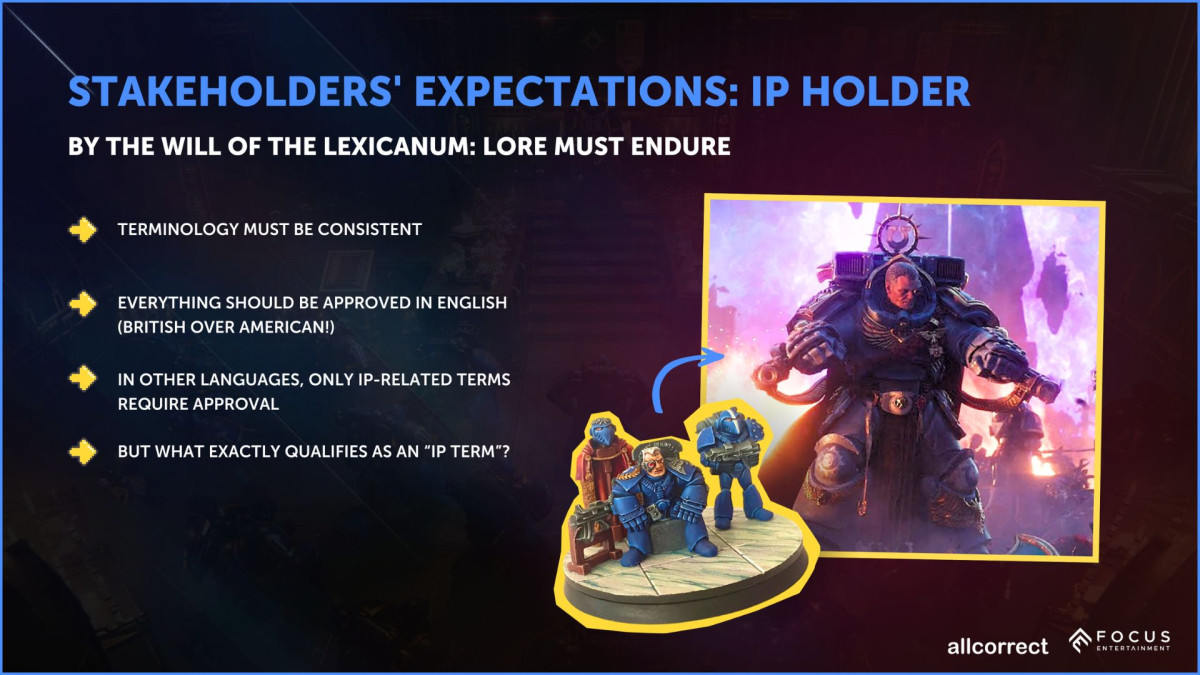
Warhammer 40,000 is a very rich and complex IP that has spanned multiple media for almost 40 years.
To make sure the tone of the universe is respected and the narration stays true to the lore, Games Workshop needs to read and approve all the English texts and dialogue.
Strict guidelines had to be followed to get their approval. For example, several lines had to be re-recorded because the actors pronounced Lieutenant the American way, “Lootenant,” instead of using the British pronunciation.
Now, the IP holder can’t realistically be involved at that level for all languages, but they still have a way to maintain consistency: it’s called IP terms validation.
The idea is that we don’t need to validate everything, but only the words and names that are specific to the Warhammer 40,000 universe.
Sometimes it’s pretty straightforward. Words like Helbrute or Tyranid, pronounced TEER-ah-nid, are clearly part of the lore. But other times, it’s a bit more ambiguous. For example, the Emperor is a central figure in the universe, but it’s also just a common noun. So, do we treat it as an IP term or not?
We did receive a large glossary from Games Workshop, but it’s not uncommon to come across a term that’s not listed.
We’ll see later how we integrated this validation process into the localization workflow.
Player expectations
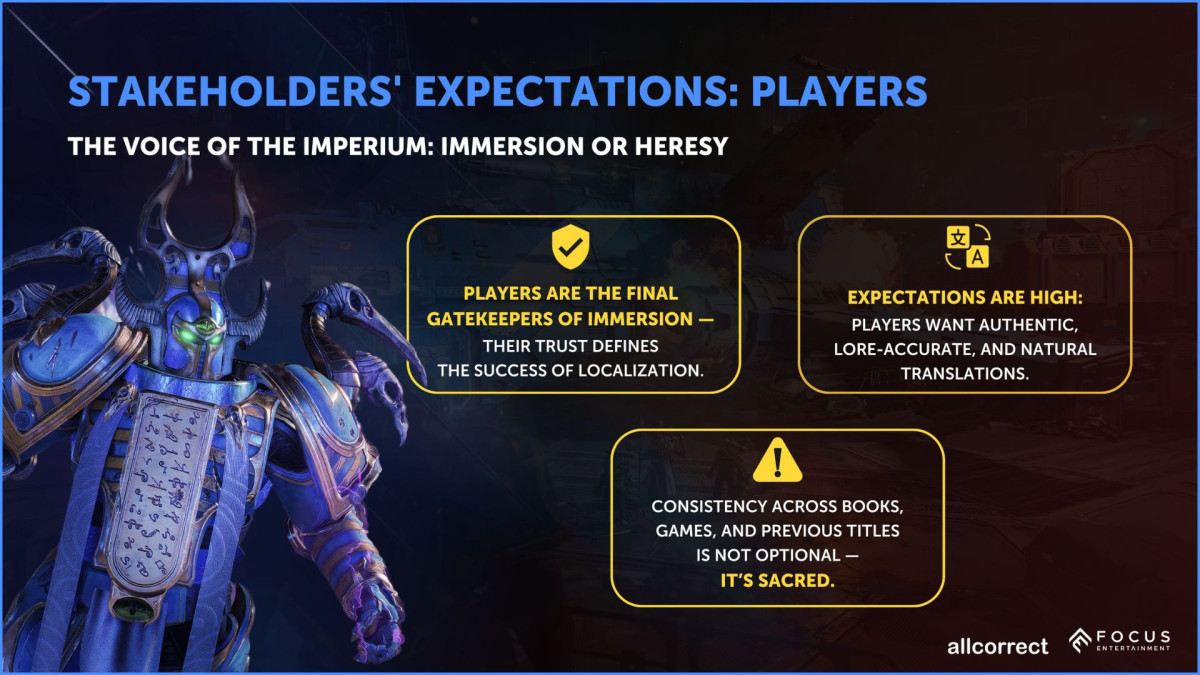
Let’s talk about one of the most important—yet often underestimated—stakeholders: the players.
From the very start, we knew that even if the publisher signed off, the dev team was aligned, and the IP holder gave us the green light… it would all be meaningless if the players didn’t buy into the experience.
Because in Warhammer 40,000, the Emperor protects, but the players decide.
As a localization studio, we weren’t going in blind. We had already worked on other games set in the Warhammer universe, so we came in with a solid understanding of player sentiment and feedback trends.
We’d seen where translations failed to capture the tone, where lore terms were mishandled, and how players reacted, especially on community forums and in reviews. So with Space Marine 2, we knew exactly what we were walking into.
Players don’t just want translated text—they want a native experience that still sounds like Warhammer.
They expect authenticity: narrative that feels like it was written in their own language, but still radiates grimdark energy.
They demand consistency. Many of them had read the novels, played the games, maybe even painted the miniatures.
And most of all, they want to feel like the game was truly made for them, not just ported and labeled as localized.
Failing to meet those expectations? That’s not just bad translation. That’s heresy.
Managing expectations with publisher alignment
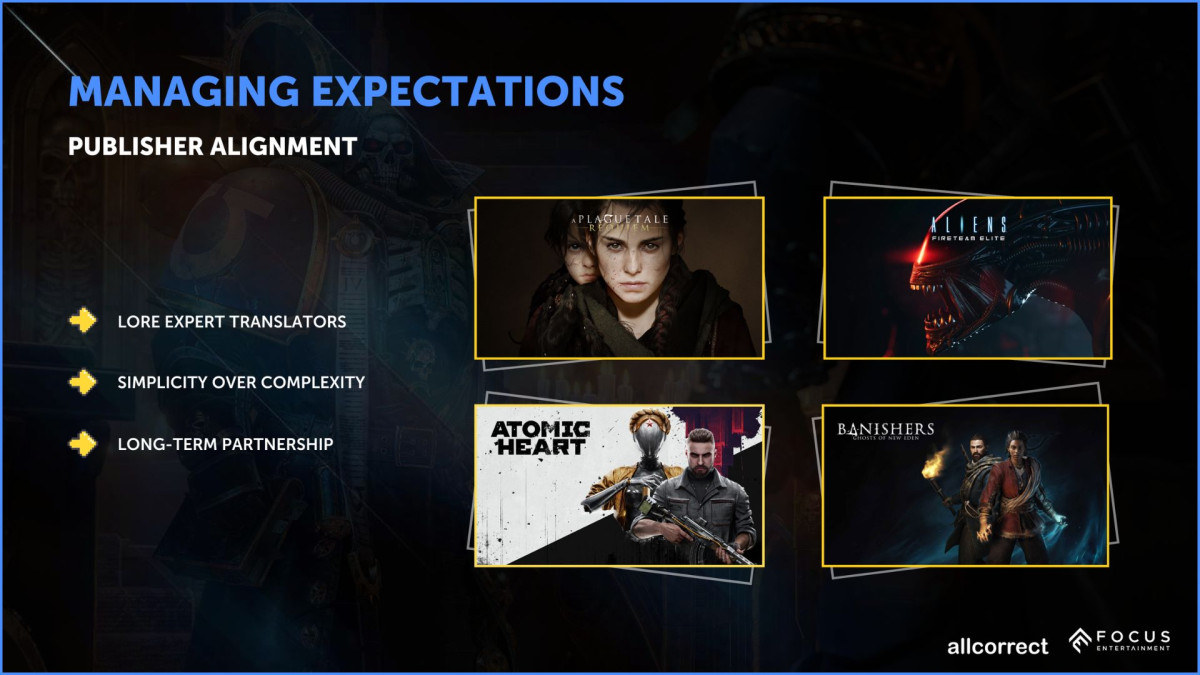
Working with Games Workshop is part of Focus Entertainment’s DNA, as this collaboration has already lasted for over 15 years.
From the start, it was obvious that the translators should be familiar with the Warhammer 40,000 universe, and that was Focus Entertainment’s main request to us, Allcorrect. Because even for top-level translators, it’s hard to immediately capture the tone and depth of that universe if they’re discovering it for the first time.
Given the stakes of this project, Focus Entertainment preferred to stick with a single localization provider that they had worked with for years.
That said, it’s definitely possible to work with different local providers or freelancers, but that’s only possible if you have full confidence in your localization pipeline and your ability to replicate the same process multiple times.
Localization on its own is already a complex process, and when you add the Games Workshop layer on top, your goal becomes simply to keep things as straightforward and efficient as possible.
Integrating localization with the dev team
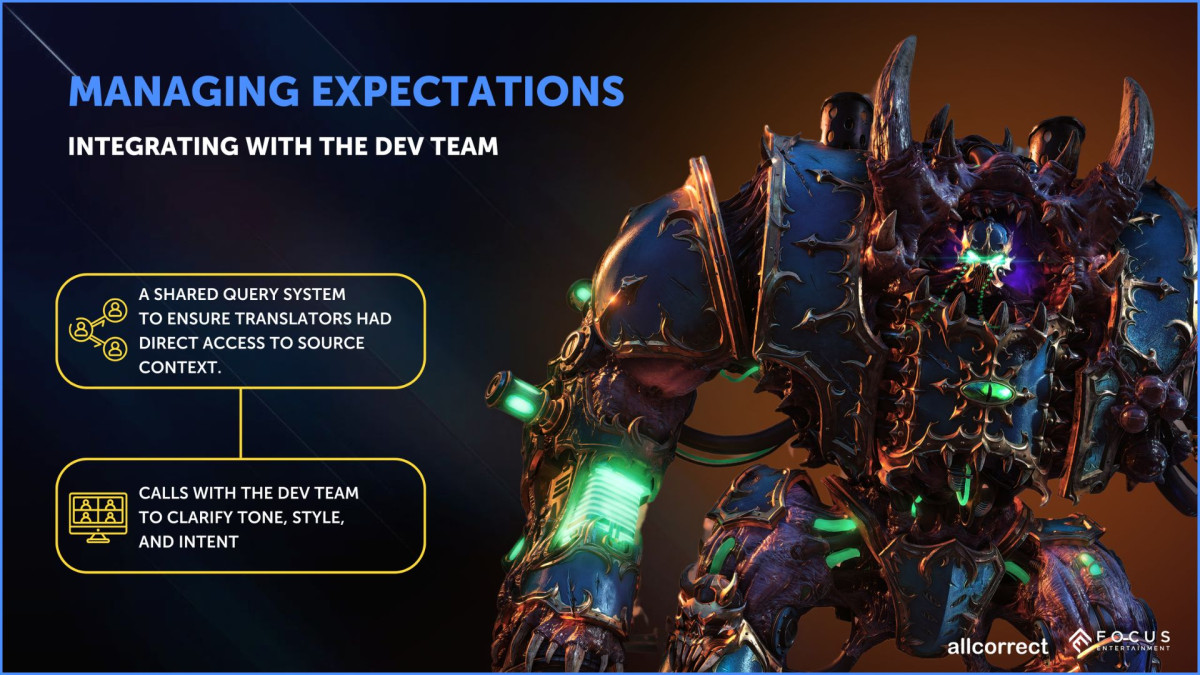
Even when you’re fully armed with Warhammer knowledge, tone guides, and glossary prep, there’s one thing we’ve learned from experience: perfect alignment doesn’t happen in isolation.
So from the very beginning, we made sure localization was part of the dev process.
We built a shared environment where translators could flag unclear lines, ask about intent, or raise concerns about tone—especially in areas heavy with lore or military jargon.
That translator query system became our first line of defense against confusion and misinterpretation. That alone saved us from a lot of blind guesses.
And beyond the spreadsheet, we made it a point to get on calls with the dev team.
That’s where some of the most important alignment happened: fruitful conversations about nuance, character voice, and that unmistakable Adeptus Astartes tone.
There was one moment early on when we received a wave of tonal feedback.
Not because we didn’t understand Warhammer—we absolutely did.
But because even with all that knowledge, some expectations still had to be negotiated.
“This doesn’t sound very military.”
“It feels too grounded—not ceremonial enough.”
“This sounds more like a folk tale than a Space Marine briefing.”
And honestly? That kind of feedback is gold.
It shows how seriously the devs take the voice of their universe, and it opened up valuable discussions that made the final product better for everyone.
Because at the end of the day, you don’t just translate Warhammer—you align with it.
Working with the IP holder
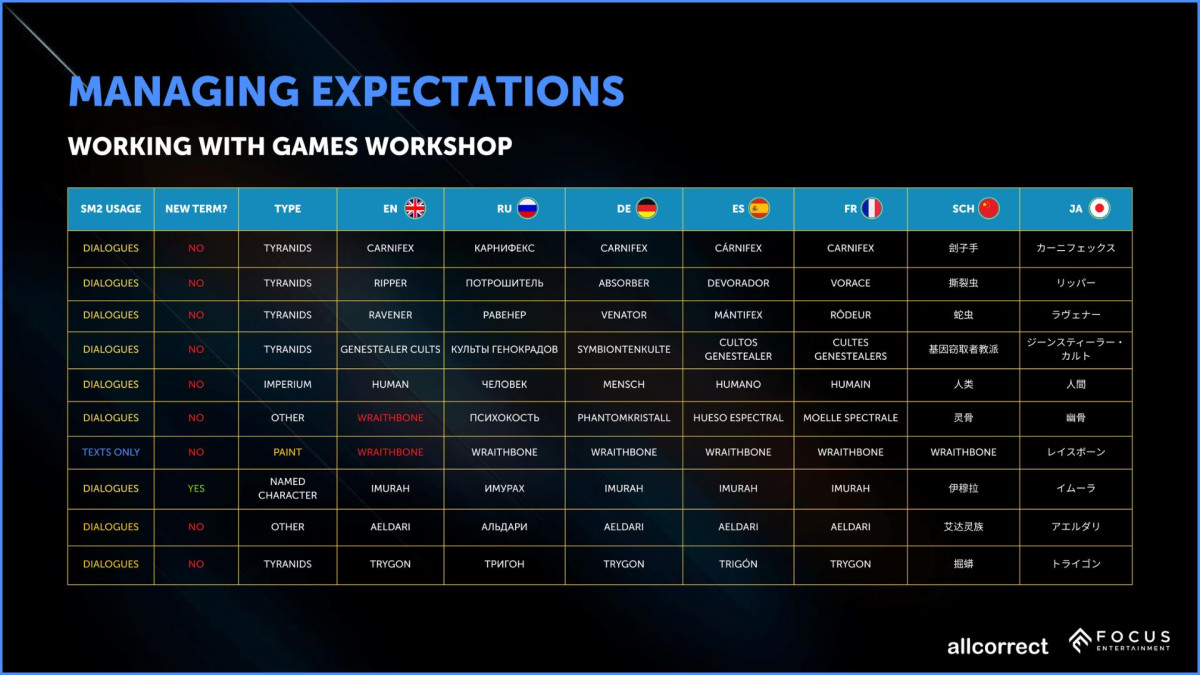
Let’s take a look at an extract from our Space Marine 2 glossary. It’ll help illustrate a few interesting cases.
Translations carry legacy—maybe some terms wouldn’t be translated the same way today, but Games Workshop prioritizes consistency over potential, and often subjective, improvements.
That said, changes do happen. A good example is the French translation of Genestealer, originally known as Génovore, then later reverted to Genestealer. The Games Workshop glossary pulls from a huge mix of sources, so if you ever spot a contradiction, just ask them.
Next, we have two entries for Wraithbone. Why two? And why do they have different translations?
Easy—one refers to the in-universe material, which should be translated. The other is the paint name, which should stay in English in most languages. This shows why translators can’t just rely on translation memories. They need context to avoid these traps.
Imurah is a new character created for the game. Even though it’s a proper name, we added it to the glossary to keep transliteration consistent in languages like Japanese or Russian. Will Games Workshop reuse the character one day? Maybe. Maybe not. But at least he’s in the glossary now.
Satisfying players worldwide
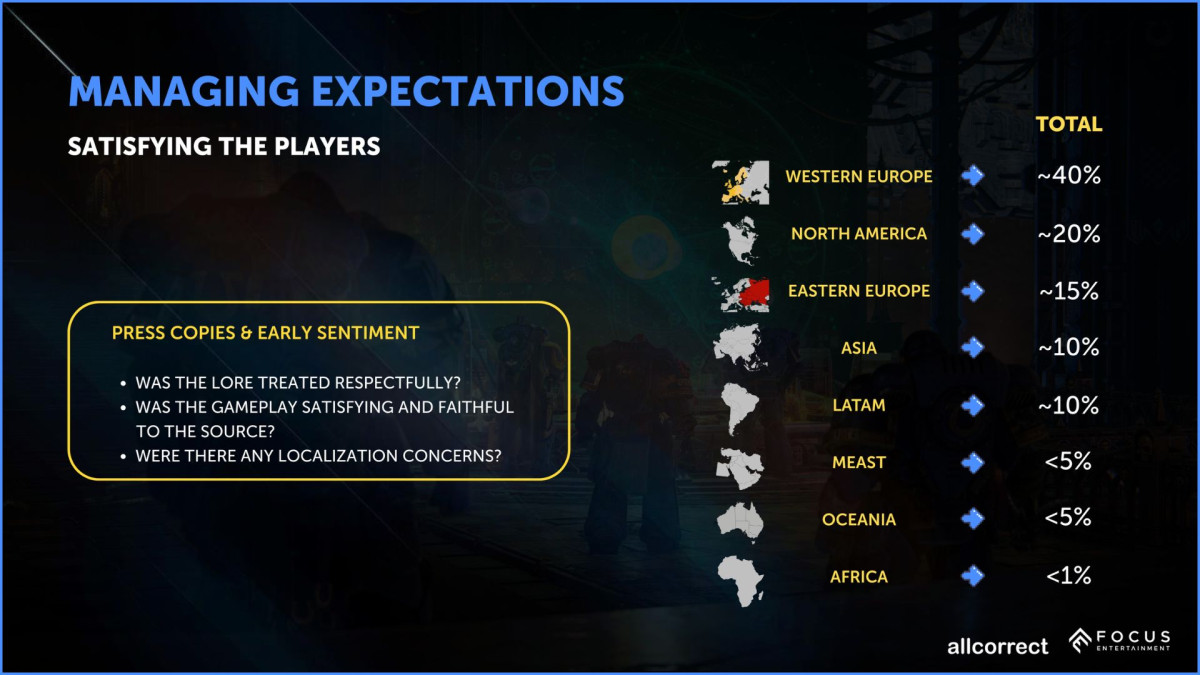
To make sure Space Marine 2 would truly resonate with players around the world, the Focus Entertainment team sent out a controlled batch of press copies across 8 different regions. Their main focus was Western Europe and North America—the historical strongholds of Warhammer 40,000, and the largest, most vocal communities.
But this wasn’t just a marketing tactic. It was an early warning system—a chance to listen to how the game was being received before launch. These previews helped us detect potential risks early, adapt our communication if necessary, and make sure that both gameplay and narrative were positioned in the right way for global audiences.
And it didn’t stop there.
Once the game was officially released, we kept our eyes peeled for real-time player feedback, especially on Steam.
We even used a dedicated tool that filters and analyzes only localization-related reviews, allowing us to spot trends, detect praise or issues early, and plan for rapid adjustments in live support.
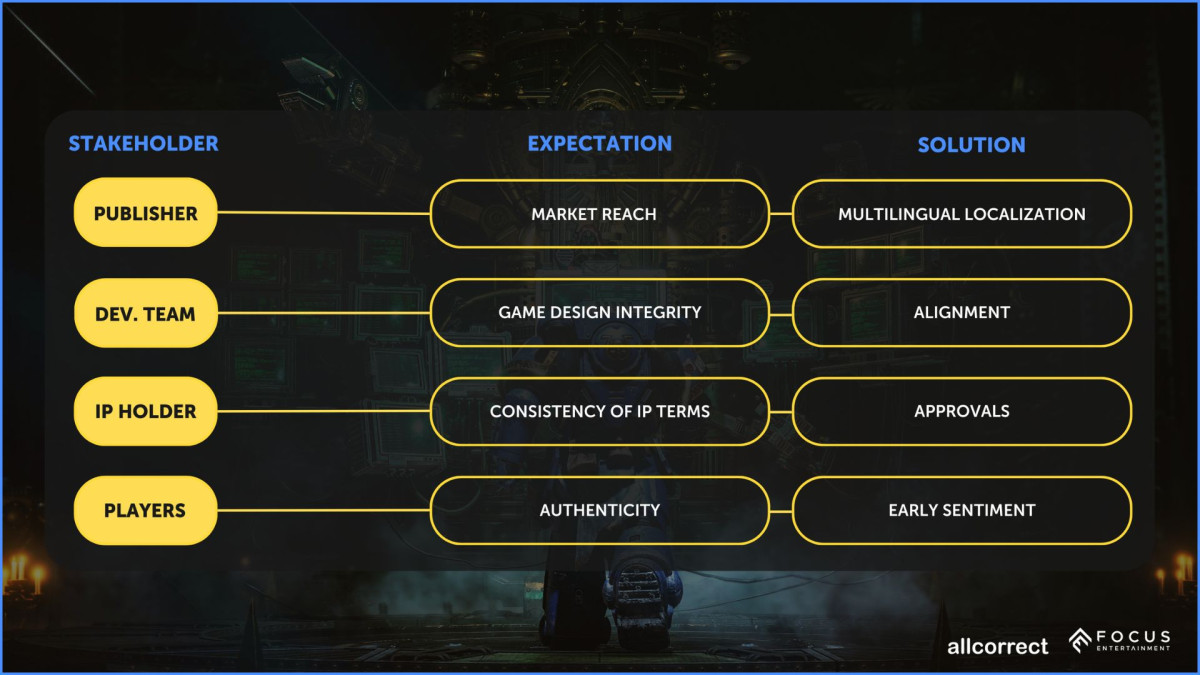
In short, gathering and reacting to localization player sentiment wasn’t just a one-time task. It was—and still is—a key part of our work.
Live support and long-term team consistency
Now, we are reaching the final part of this talk: live support.
The two main pillars of this stage are careful localization pipeline management and a stable, consistent localization team.
Let’s begin with the first one.
During development, even if translation is never simple, we’re not under the same pressure as after release.
Post-launch, everything speeds up: players want new content fast, and game designers often keep tweaking things until the last minute, so localization has to stay very flexible.
So far, every new update has been fully translated and dubbed in all the supported languages.
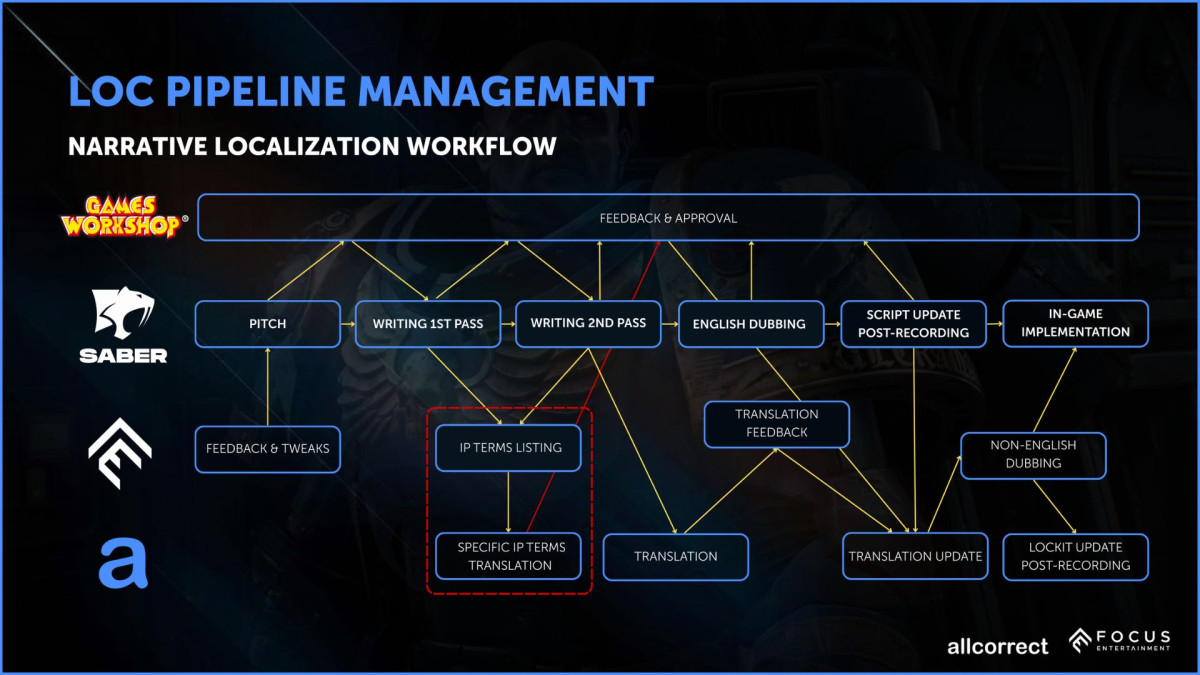
To make that possible, even with tight deadlines, a very specific process is in place:
As soon as Saber Interactive finishes writing, even if it’s not yet final, the script should be reviewed and every new IP term has to be highlighted. Most of the time, we can wait and include those terms in the full translation batch. But sometimes, they need to be translated right away and then sent to Games Workshop for approval as early as possible.
It’s a proactive step, but it’s crucial because you don’t want anything unapproved ending up in the dubbing sessions, especially with this kind of timing.
Another way to save time is to record English and the other dubs at the same time.
And yes, that can really help, but it’s riskier, both technically and in terms of overall quality.
One of the biggest challenges is keeping your localization team stable and consistent over time.
And honestly, from my side as the account manager, I’m not involved in the day-to-day production details. My role is more about overseeing the big picture and making sure everything runs smoothly.
So when I thought about what really kept our team stable, I went straight to the person who would know best: our project manager. Her first answer to my question, “So, how do we manage to keep the team stable?” was hassle-free scheduling, with appreciation to the Focus Entertainment team for manageable deadlines.
And second:
“Why would anybody leave such an awesome project?”
Because at the end of the day, working on something like Space Marine 2, a title packed with so much lore, energy, and fan love—it’s not just another gig. It’s a project you want to stay on, fight for, and see through to the end.


